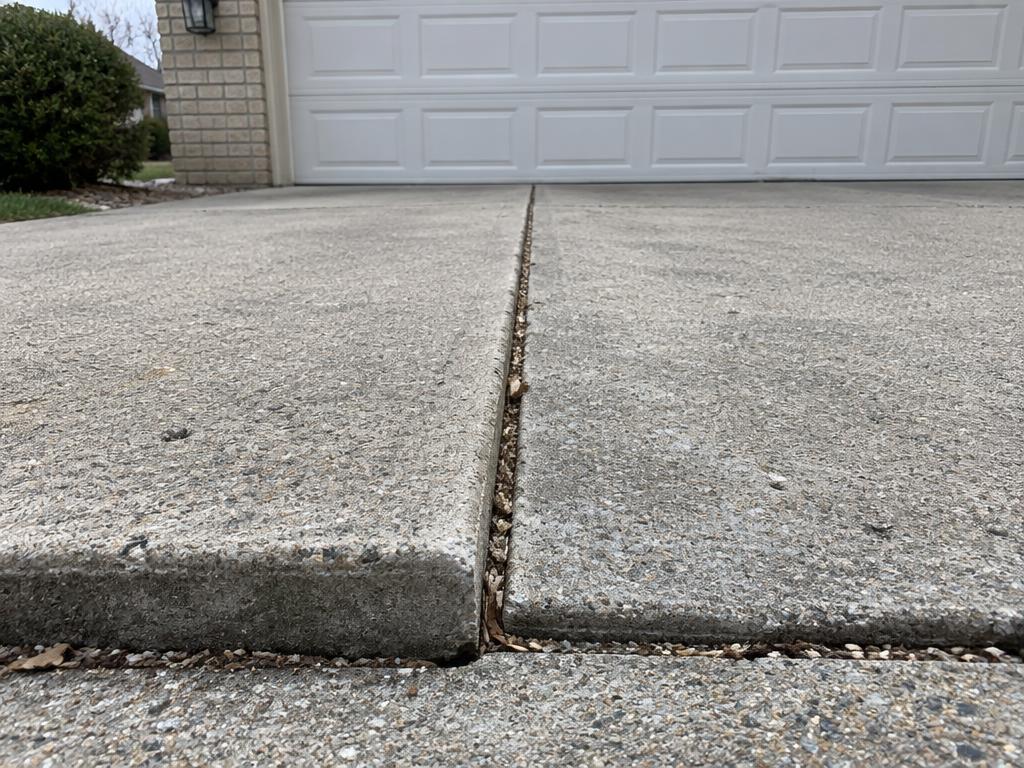
Driveway leveling lifts sunken driveway slabs to reduce trip hazards and redirect water away from garages and foundations.
Why concrete settles in Topeka
Driveways, walks and patios rest on a base over native soil. Roof runoff and open joints wash fine soil out from under slabs, and clay soils shrink away from the underside during drought. Backfill beside foundation walls is often less compacted than native soil, which is why aprons, stoops and walks next to the house commonly sink.
Freeze-thaw cycles in Topeka winters widen open joints when water gets in and freezes. Lifting a slab works best together with sealing joints and moving downspout discharge away from the concrete.
Common warning signs
- Slab drop at the garage
- Uneven joints
- Water flowing toward the house
What you might observe and what it may indicate
| Observation | May indicate |
|---|---|
| Slab drop at a joint | Void from washout |
| Patio tipping toward house | Settlement; directs water to foundation |
| Slab raised, not sunk | Root or frost heave; leveling may not apply |
Observations suggest possibilities only; they are not a diagnosis.
Possible causes and risk factors
- Base erosion
- Settled fill
How a professional assesses it
Slab condition and drainage are reviewed.
Diagnostic steps
- Measure how far the slab has dropped and in which direction it tips.
- Tap the slab to find hollow-sounding voids.
- Check crack pattern and whether the slab is mostly in one piece.
- Find the water source undermining the slab: downspouts, joints, slope.
- Confirm whether a sidewalk is in city right-of-way.
Investigation checklist
- Drop measurement
- Void check
- Slab condition
- Drainage source
- Utilities and right-of-way
Repair methods
Mudjacking or polyjacking
Chosen based on slab and void conditions.
Polyjacking vs. mudjacking
| Factor | Polyjacking | Mudjacking |
|---|---|---|
| Material | High-density expanding polyurethane foam | Cementitious slurry (cement, soil/sand, water) |
| Injection hole size | About 5/8 in | About 1–2 in |
| Material weight | Roughly 2–4 lb per cubic foot | Roughly 100+ lb per cubic foot |
| Cure time | Usable in minutes to hours | Typically 24–72 hours |
| Typical cost | $5–$25 per sq ft | $3–$8 per sq ft |
What affects the scope and cost
- Number of slabs
Cost guidance
| Item | Low | High | Unit |
|---|---|---|---|
| Mudjacking | $3 | $8 | per square foot |
| Polyjacking (polyurethane foam) | $5 | $25 | per square foot |
| Typical mudjacking job | $662 | $1,884 | per project |
Usually included
- Drilling injection ports
- Lifting material and injection
- Patching ports
Often extra
- Joint sealing or caulking (sometimes extra)
- Replacing broken slabs
- Minimum trip charges (often ~$500)
National figures, not quotes. Sources: Angi, “How Much Does Mudjacking Cost?”; Angi, “Polyurethane Concrete Lifting Cost”. Topeka prices vary with your home, access and scope; the participating contractor provides a written estimate after an assessment.
No repair can be recommended from symptoms alone. Major structural issues may call for a structural engineer's evaluation.
Frequently asked questions
Can you tell me what's wrong from a photo?
Photos help a contractor prepare, but foundation and water problems can't be reliably diagnosed from pictures alone. An on-site assessment looks at measurements, drainage, soil conditions and the structure as a whole.
How much will it cost?
Pricing depends on the size of the problem, access, the repair method and site conditions. This website doesn't publish prices; the participating contractor provides a written estimate after assessing your property.
About this page
- Written by:
- Topeka Foundation Repair editorial team
- Technical reviewer:
- Pending technical review
- Published:
- Last reviewed:
- Status:
- Awaiting technical review
Sources
- Web Soil Survey (Shawnee County, KS soil map units and shrink-swell ratings) — USDA Natural Resources Conservation Service
- How Much Does Mudjacking Cost? — Angi
- Polyurethane Concrete Lifting Cost — Angi