
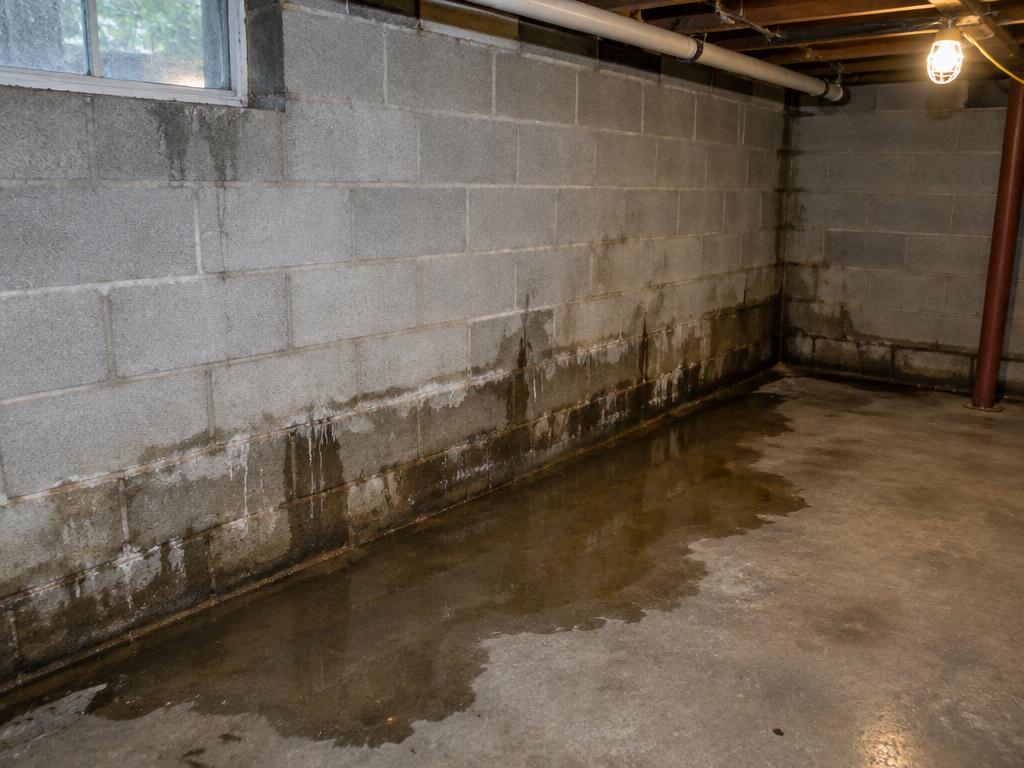
A wet basement can be caused by groundwater, surface runoff, condensation or plumbing. Identifying the source comes first because each one is fixed differently.
Why Topeka basements take on water
Clay soils drain slowly, so after heavy spring and early-summer storms the backfill around a basement can stay saturated. Water in the soil exerts hydrostatic pressure, about 62 pounds per square foot for each foot of water depth, which pushes water through the cove joint, cracks, form-tie holes and pipe penetrations.
Neighborhoods on low ground near the Kansas River or along Shunganunga Creek and its tributaries can have seasonally higher groundwater. Many older homes were built without functioning footing drains. The International Residential Code now requires foundation drainage and damp-proofing or waterproofing for new basements.
Common warning signs
- Standing water
- Damp carpet
- Condensation on walls in summer
What you might observe and what it may indicate
| Observation | May indicate |
|---|---|
| Water at floor-wall joint | Hydrostatic pressure; no working footing drain |
| Efflorescence on walls | Water moving through masonry |
| Damp only in summer | Condensation |
| Pump runs nonstop | High inflow, bad check valve, undersized pump |
Observations suggest possibilities only; they are not a diagnosis.
Possible causes and risk factors
- Groundwater
- Surface drainage
- Humidity
- Plumbing leaks
How a professional assesses it
Source tracing may include checking after rain and testing whether moisture comes through the wall or forms on its surface.
Diagnostic steps
- Record where water appears and how long after rain it starts.
- Rule out condensation: tape plastic to the wall for a few days and see which side gets wet.
- Check gutters, downspout discharge and grading on the side where water enters.
- Inspect the existing sump: basin, float, check valve, discharge route and age.
- Look for wall movement; a leaking horizontal crack may be structural.
- Note finished walls or floors that would need removal for drainage work.
Investigation checklist
- Entry points and timing
- Condensation test
- Exterior drainage
- Sump condition
- Wall movement
- Electrical for pumps
Repair methods
Drainage
Interior or exterior drain systems.
Dehumidification
For condensation-driven dampness.
What affects the scope and cost
- Source
- Area affected
Cost guidance
| Item | Low | High | Unit |
|---|---|---|---|
| Interior perimeter drain tile | $40 | $85 | per linear foot |
| Primary sump pump, installed | $800 | $1,500 | per pump |
| Dual pumps or multiple pits | $2,000 | $4,000 | per system |
| Typical waterproofing project | $2,461 | $8,205 | per project |
Usually included
- Floor cutting and removal along the wall
- Pipe, gravel, wall membrane and new concrete
- Basin and pump where specified
Often extra
- Permits ($100–$500 per Angi)
- Removing or replacing finished walls and flooring
- Mold remediation
- Exterior grading and gutters
National figures, not quotes. Sources: Angi, “Basement Drain Installation Cost”; Angi, “Sump Pump Installation Cost”; Angi, “How Much Does Basement Waterproofing Cost?”. Topeka prices vary with your home, access and scope; the participating contractor provides a written estimate after an assessment.
No repair can be recommended from symptoms alone. Major structural issues may call for a structural engineer's evaluation.
Frequently asked questions
Can you tell me what's wrong from a photo?
Photos help a contractor prepare, but foundation and water problems can't be reliably diagnosed from pictures alone. An on-site assessment looks at measurements, drainage, soil conditions and the structure as a whole.
How much will it cost?
Pricing depends on the size of the problem, access, the repair method and site conditions. This website doesn't publish prices; the participating contractor provides a written estimate after assessing your property.
About this page
- Written by:
- Topeka Foundation Repair editorial team
- Technical reviewer:
- Pending technical review
- Published:
- Last reviewed:
- Status:
- Awaiting technical review
Sources
- International Residential Code, Chapter 4: Foundations (drainage, damp-proofing, under-floor space) — International Code Council
- Web Soil Survey (Shawnee County, KS soil map units and shrink-swell ratings) — USDA Natural Resources Conservation Service
- Basement Drain Installation Cost — Angi
- Sump Pump Installation Cost — Angi
- How Much Does Basement Waterproofing Cost? — Angi