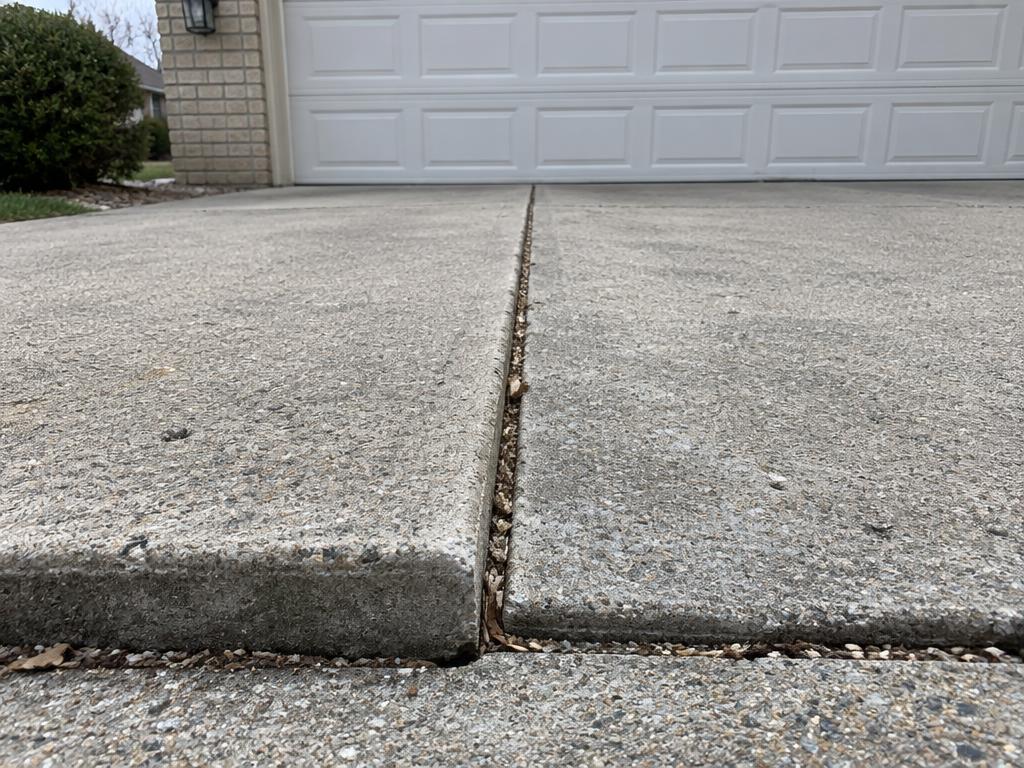
How voids form under Topeka concrete
Slabs float on a compacted base over native soil. When roof runoff, a downspout or a leaking joint sends water under a slab, fine soil washes out and a void forms. Clay soils add a second mechanism: in drought they shrink and pull away from the slab's underside, and over repeated cycles the slab loses support at edges and corners first. Backfill next to a foundation wall, which is often less compacted than native soil, is a common place for driveway aprons, stoops and walks to sink.
Once a void exists, the slab acts like an unsupported beam. It cracks under vehicle loads, tips toward the house, and creates trip hazards at joints. Freeze-thaw cycles in Topeka winters can widen open joints when water gets in and freezes.
Polyjacking: high-density polyurethane
Polyjacking drills small ports, about 5/8 inch, and injects a two-part polyurethane that expands and hardens. Structural lifting foams typically have densities of roughly 2 to 4 pounds per cubic foot, so they add very little weight to soils that may already be weak. The foam is hydrophobic, which resists washout, and most slabs can be used within minutes to hours. Its cost per square foot is higher than mudjacking.
Mudjacking: cementitious slurry
Mudjacking pumps a slurry of cement, soil or sand and water through larger holes, about 1 to 2 inches. It's been used for decades and costs less per square foot. The slurry is heavy, often more than 100 pounds per cubic foot, which can add load to soft soil, and it needs time to cure before heavy traffic. Patches are larger and more visible.
Is your slab a good candidate?
Leveling works best when the slab is mostly in one piece, has settled rather than heaved, and the cause of settlement can be addressed. Slabs broken into many pieces, badly spalled or crumbling surfaces, and concrete that has heaved upward from tree roots or frost are usually better replaced. A contractor should check slab thickness, crack pattern, void extent, and where water is coming from.
Fixing the cause
Lifting a slab without changing the drainage that undermined it invites a repeat. Route downspouts away from walks and drives, seal joints with a flexible sealant to keep water out, and correct slopes so water runs off the slab and away from the house. A slab that pitches toward the foundation can contribute to basement seepage, so leveling a patio or apron can help the basement too.
Sidewalks and city right-of-way
Sidewalks along the street may sit in city right-of-way, where repair responsibility and allowed methods can differ from private walks. Check with the City of Topeka before work on public sidewalks.
Concrete near the foundation
Stoops, porches, driveway aprons and patios attached to the house deserve extra attention. When they settle toward the foundation, they can trap water against the wall and feed basement seepage or saturate the clay that pushes on the wall. Leveling these slabs so they pitch away from the house, then sealing the joint between slab and foundation with a flexible sealant, is often one of the most cost-effective drainage improvements a Topeka homeowner can make. If a porch or stoop is separating from the house itself, the contractor may recommend piers rather than slab lifting, because the footing beneath the porch may be shallower than the house's.
What to expect on project day
Most residential leveling jobs finish within a day. The crew drills ports in a planned pattern, injects material while monitoring lift with a level or laser, patches ports, and may seal joints. Lifting is gradual to avoid cracking the slab. Expect some ports to remain visible after patching.
Common warning signs
- Trip hazards at joints
- Slabs sloping toward the house
- Water pooling on concrete
What you might observe and what it may indicate
| Observation | May indicate |
|---|---|
| Slab edge drops at a joint | Void under that slab from washout or base settlement |
| Driveway apron sunk at the garage | Poorly compacted backfill near the foundation wall |
| Patio tilted toward the house | Settlement; may direct water to the foundation |
| Hollow sound when tapping concrete | Void beneath the slab |
| Slab raised, not sunk | Heave from roots or frost; leveling may not apply |
Observations suggest possibilities only; they are not a diagnosis.
Possible causes and risk factors
- Soil washout
- Poorly compacted base
- Clay shrinkage
How a professional assesses it
The contractor checks slab condition, cracking, void size and drainage.
Investigation checklist
- Slab condition, thickness and crack pattern
- Amount and direction of settlement
- Downspouts, runoff and joint condition
- Proximity to foundation, utilities and sprinkler lines
- Public right-of-way status for sidewalks
Repair methods
Mudjacking
Cement-based slurry pumped beneath the slab.
Polyjacking
Expanding polyurethane foam injected through small holes.
Polyjacking vs. mudjacking
| Factor | Polyjacking | Mudjacking |
|---|---|---|
| Material | High-density expanding polyurethane foam | Cementitious slurry (cement, soil/sand, water) |
| Injection hole size | About 5/8 in | About 1–2 in |
| Material weight | Roughly 2–4 lb per cubic foot | Roughly 100+ lb per cubic foot |
| Cure time | Usable in minutes to hours | Typically 24–72 hours |
| Typical cost | $5–$25 per sq ft | $3–$8 per sq ft |
What affects the scope and cost
- Slab area
- Void size
- Method
Cost guidance
| Item | Low | High | Unit |
|---|---|---|---|
| Mudjacking | $3 | $8 | per square foot |
| Polyjacking (polyurethane foam) | $5 | $25 | per square foot |
| Typical mudjacking job | $662 | $1,884 | per project |
Usually included
- Drilling injection ports
- Lifting material and injection
- Patching ports
Often extra
- Joint sealing or caulking (sometimes extra)
- Replacing broken slabs
- Minimum trip charges (often ~$500)
National figures, not quotes. Sources: Angi, “How Much Does Mudjacking Cost?”; Angi, “Polyurethane Concrete Lifting Cost”. Topeka prices vary with your home, access and scope; the participating contractor provides a written estimate after an assessment.
No repair can be recommended from symptoms alone. Major structural issues may call for a structural engineer's evaluation.
Frequently asked questions
How soon can I drive on a lifted driveway?
With polyurethane, often the same day. With mudjacking, contractors commonly advise waiting a day or more. Follow the installer's guidance.
Will the holes be visible?
Ports are patched with cement or color-matched material but usually remain somewhat visible, especially the larger mudjacking holes.
Can leveling fix cracks in the slab?
Leveling restores support and alignment; existing cracks remain. They can be sealed afterward.
Can garage floors and interior slabs be lifted?
Often yes, especially with polyurethane. Interior slabs under walls or appliances need careful planning.
Is concrete leveling cheaper than replacement?
Leveling is commonly less expensive than tearing out and repouring, according to published cost guides, but it only makes sense if the slab is in good enough shape to lift.
Leveling or replacement?
Badly broken slabs may need replacement; intact slabs are often good leveling candidates.
Can you tell me what's wrong from a photo?
Photos help a contractor prepare, but foundation and water problems can't be reliably diagnosed from pictures alone. An on-site assessment looks at measurements, drainage, soil conditions and the structure as a whole.
How much will it cost?
Pricing depends on the size of the problem, access, the repair method and site conditions. This website doesn't publish prices; the participating contractor provides a written estimate after assessing your property.
About this page
- Written by:
- Topeka Foundation Repair editorial team
- Technical reviewer:
- Pending technical review
- Published:
- Last reviewed:
- Status:
- Awaiting technical review
Sources
- How Much Does Mudjacking Cost? — Angi
- Polyurethane Concrete Lifting Cost — Angi
- Web Soil Survey (Shawnee County, KS soil map units and shrink-swell ratings) — USDA Natural Resources Conservation Service
- Bulletin 208: Using Soils of Kansas for Waste Disposal (montmorillonite clay behavior) — Kansas Geological Survey