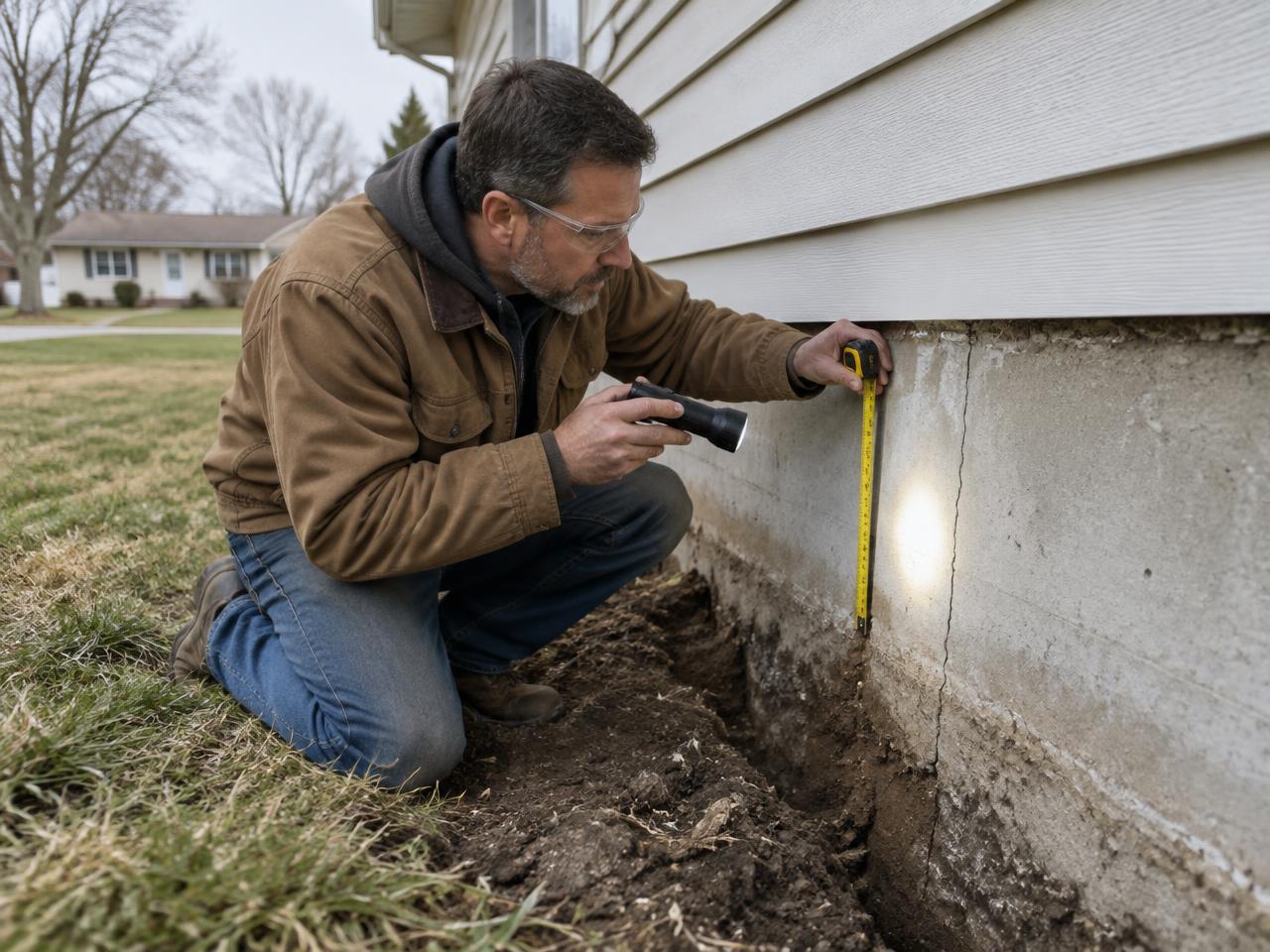
Settlement happens when soil beneath part of a footing compresses or loses moisture, letting that section of the home drop. Repair usually means transferring the load to deeper, more competent soil.
Topeka soil and foundation conditions
Many Shawnee County soils contain smectite clays, mainly montmorillonite, which the Kansas Geological Survey describes as expanding when water enters between its crystal layers and shrinking as it dries. The USDA NRCS Web Soil Survey rates numerous local map units moderate to high for shrink-swell, and you can check your own lot. Wet springs swell the clay and push on walls; late-summer drought shrinks it and lets footings lose support.
Topeka's amended residential code requires exterior footings at least 36 inches below finished grade for frost protection. Older homes, porches, garages and additions may be shallower, which can make them more sensitive to frost and moisture swings. Where downspouts discharge, where a large tree draws water, or where the yard slopes toward the house, movement is typically greatest.
Common warning signs
- Sloping floors toward one side
- Diagonal cracks above doors and windows
- Stair-step cracks in brick or block
- Doors that drift open or closed
- Gaps where exterior walls meet the foundation
What you might observe and what it may indicate
| Observation | May indicate |
|---|---|
| Hairline vertical crack, no offset | Concrete shrinkage |
| Horizontal crack in basement wall | Lateral soil pressure |
| Stair-step crack in block or brick | Differential settlement or wall movement |
| Crack wider at top than bottom | Settlement at one end of the wall |
| Sloping floor toward one side | Footing settlement on that side |
Observations suggest possibilities only; they are not a diagnosis.
Possible causes and risk factors
- Clay soils shrinking during drought
- Poorly compacted fill under the footing
- Erosion from leaking gutters or plumbing
- Tree roots drawing moisture from soil
How a professional assesses it
Elevation readings across the floor identify where and how much the home has dropped. The contractor will consider soil type and may recommend engineering for larger movement.
Diagnostic steps
- Map every crack: location, direction, width (a crack gauge or coin helps) and whether one side is offset.
- Take floor elevation readings to find high and low points and the pattern of movement.
- Check basement walls for plumb and inward deflection with a level or string line.
- Walk the exterior: grading, gutters, downspout discharge, trees and concrete flatwork.
- Look for evidence of plumbing leaks or past water entry near the affected area.
- Decide whether the movement is active by comparing to dated marks or past photos.
- Refer to a licensed structural engineer when movement is significant or a lender requires it.
Investigation checklist
- Crack map with widths
- Floor elevation survey
- Wall deflection readings
- Drainage and grading review
- Footing depth at excavations
- Permit and engineering needs
Repair methods
Push piers
Steel pipe hydraulically driven to load-bearing strata using the home's weight as resistance.
Helical piers
Screw-like steel shafts turned into the soil; useful for lighter structures or where weight is limited.
Lift where possible
Some homes can be partially lifted back toward level; full recovery is never guaranteed.
Push piers vs. helical piers
| Factor | Push piers | Helical piers |
|---|---|---|
| How installed | Driven hydraulically using the home's weight as reaction | Screwed in with a hydraulic torque motor |
| Best suited to | Heavier structures with enough weight to drive the pier | Lighter structures: porches, additions, slab homes |
| Capacity check | Drive pressure at refusal | Installation torque correlated to capacity |
| Typical installed cost | About $1,000–$2,000 per pier | About $2,000–$4,000 per pier |
What affects the scope and cost
- Length of footing affected
- Pier depth
- Interior versus exterior access
Cost guidance
| Item | Low | High | Unit |
|---|---|---|---|
| Steel push pier, installed | $1,000 | $2,000 | per pier |
| Helical pier, installed | $2,000 | $4,000 | per pier |
| Typical foundation repair project (all types) | $2,225 | $8,133 | per project |
Usually included
- Excavation at each pier location
- Pier, bracket and installation
- Backfill at pier locations
Often extra
- Structural engineer report
- Permits
- Concrete, landscaping or interior finish restoration
- Interior pier access through finished floors
National figures, not quotes. Sources: Angi, “Pier and Beam Foundation Repair Cost (per-pier pricing)”; HomeGuide, “Bowing Basement Wall Repair Cost”; Angi, “How Much Does Foundation Repair Cost?”. Topeka prices vary with your home, access and scope; the participating contractor provides a written estimate after an assessment.
No repair can be recommended from symptoms alone. Major structural issues may call for a structural engineer's evaluation.
Frequently asked questions
Will piers lift my house back to level?
Piers can sometimes recover part of the settlement, but the goal is stabilization. Any lift is limited by the structure and is assessed carefully.
Is some settlement normal?
Minor early settlement is common in new homes. Ongoing or uneven movement is what warrants evaluation.
Can you tell me what's wrong from a photo?
Photos help a contractor prepare, but foundation and water problems can't be reliably diagnosed from pictures alone. An on-site assessment looks at measurements, drainage, soil conditions and the structure as a whole.
How much will it cost?
Pricing depends on the size of the problem, access, the repair method and site conditions. This website doesn't publish prices; the participating contractor provides a written estimate after assessing your property.
About this page
- Written by:
- Topeka Foundation Repair editorial team
- Technical reviewer:
- Pending technical review
- Published:
- Last reviewed:
- Status:
- Awaiting technical review
Sources
- Bulletin 208: Using Soils of Kansas for Waste Disposal (montmorillonite clay behavior) — Kansas Geological Survey
- Web Soil Survey (Shawnee County, KS soil map units and shrink-swell ratings) — USDA Natural Resources Conservation Service
- Topeka Municipal Code 14.55.470 — Minimum footing depth — City of Topeka
- ACI 224.1R: Causes, Evaluation, and Repair of Cracks in Concrete Structures — American Concrete Institute
- Pier and Beam Foundation Repair Cost (per-pier pricing) — Angi
- Bowing Basement Wall Repair Cost — HomeGuide
- How Much Does Foundation Repair Cost? — Angi